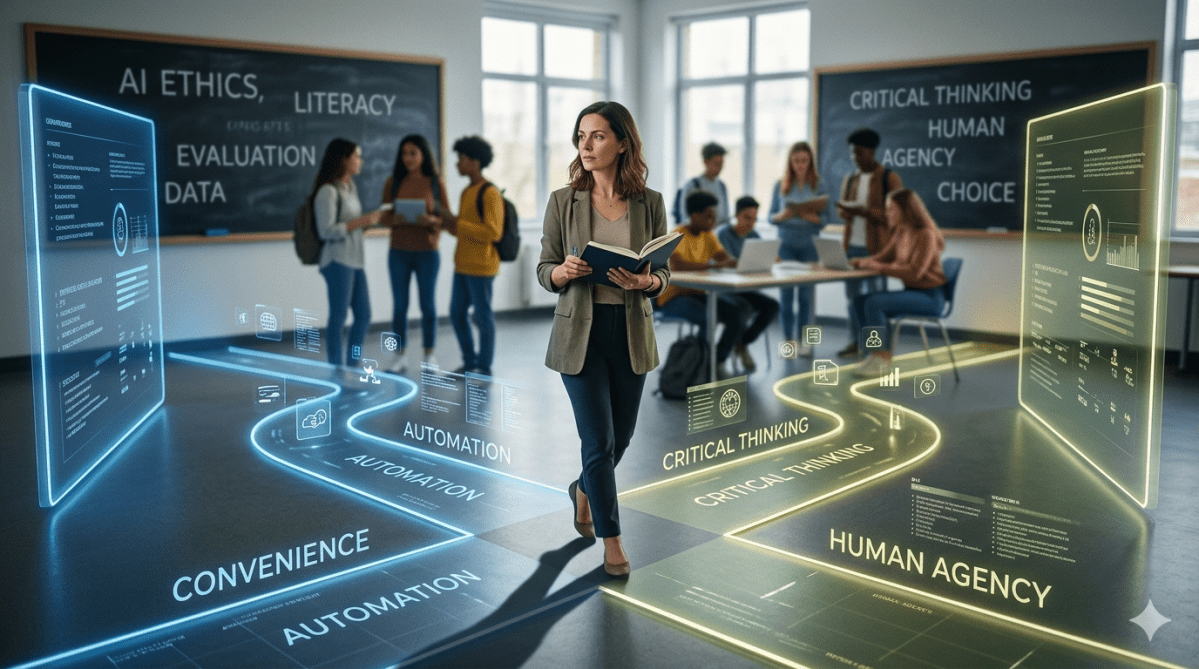
A few years ago, I shared my initial thoughts on generative artificial intelligence (AI) and the emerging AI Revolution. In recent months, my desire for professional development led me to the University of San Diego’s AI in Education certification program. Today I want to focus on an important common thread I’ve noticed throughout my certification: the importance of ethics and literacy when using AI.
Ethical AI and AI Literacy Skills
According to the 2025 Annual Global Student Wellbeing Survey USA Report, 82% of college students are using AI (Studiosity, 2025, p. 7). With AI use becoming the norm in the learning environment, the question is no longer if it will be used, but how AI can be used ethically and responsibly. The answer comes through being equipped with AI literacy skills, which is necessary for both students and educators. As Yi et al. (2025) point out, AI literacy skills are a combination technical skills and analytical reasoning. Students and educators not only need to know how to think critically about the responses generated by AI, but also how to locate and verify the credibility of the primary sources behind the response (Yi et al., 2025). Cultivating AI ethics and AI literacy skills is an ongoing process, and certification programs like the one I’m in through the University of San Diego help build a roadmap to strengthen these skills.
The first two classes I’ve taken in the certificate, Intro AI in Education and AI in Student Engagement, introduced me to several new insights as well as tools that I’ve enjoyed experimenting with (including Gemini and Brisk Teaching). A helpful resource that I found during my studies was an AI Glossary created by SchoolAI. Additionally, Walter’s (2024) article, Embracing the future of AI in the Classroom provided helpful ideas. I especially appreciated Table 5: AI Challenges and the Critical Thinking steps to help educators and students grow in both ethical AI practices and AI literacy (Walter, 2024, p. 21). Ultimately, these tools and resources are a small reflection of the ways our broader technological system is continually adapting to our current reality.
In my Philosophy & Communication class during my PhD program, we discussed Jaques Ellul’s (1981) Perspectives on our Age, in which he reflects on the natural, societal, and technological milieus (i.e., systems) we live in. Ellul believed that a system is “not only the place in which a person lives, but also the place from which a means of survival is drawn” (p. 59). When even one element in the technological system is advanced to the next stage, or a brand new element is added to the system, such as AI, every other element that is already in the system reacts. Just as the technological system adapts to new stages and elements, we must also adapt to these new stages and elements in our everyday lives.
Final Thoughts
AI brings incredible benefits to all aspects of life, including education. However, as with any new stage or element, challenges are inevitable. We have witnessed these challenges over the last few years through student cheating/plagiarism, overreliance on AI by students and educators, and AI bias. How we choose to navigate and overcome these AI challenges in education will ensure we not only survive, but also thrive, in the ever-evolving technological system we find ourselves in.
References
Ellul, J. (1981). Perspectives on our age: Jacques Ellul speaks on his life and work. Post Horizon Booksellers.
Furze, L. (2023, March 6). Teaching AI ethics: Bias and discrimination.
Google Gemini. (2026). Image visualizing ethical decision-making in a classroom. [Computer software]. Generated April 15, 2026.
Studiosity. (2025). Annual global student wellbeing survey USA report (YouGov, Comp.).
Walter, Y. (2024). Embracing the future of artificial intelligence in the classroom: The relevance of AI literacy, prompt engineering, and critical thinking in modern education. International Journal of Educational Technology in Higher Education, 21(15), 1-29. https://doi.org/10.1186/s41239-024-00448-3
Yi, F., Taggart, J., & Mickel, B. (2025). Fostering AI literacy: A guide for educators in higher education. Pressbooks.


